What Surveyors Really Look For Under F679
A practical guide for Activity Professionals who want to understand what surveyors are really evaluating — and why F679 is about much more than a monthly activity calendar.
Activity Directors Network • Supporting Activity Professionals for 30+ Years
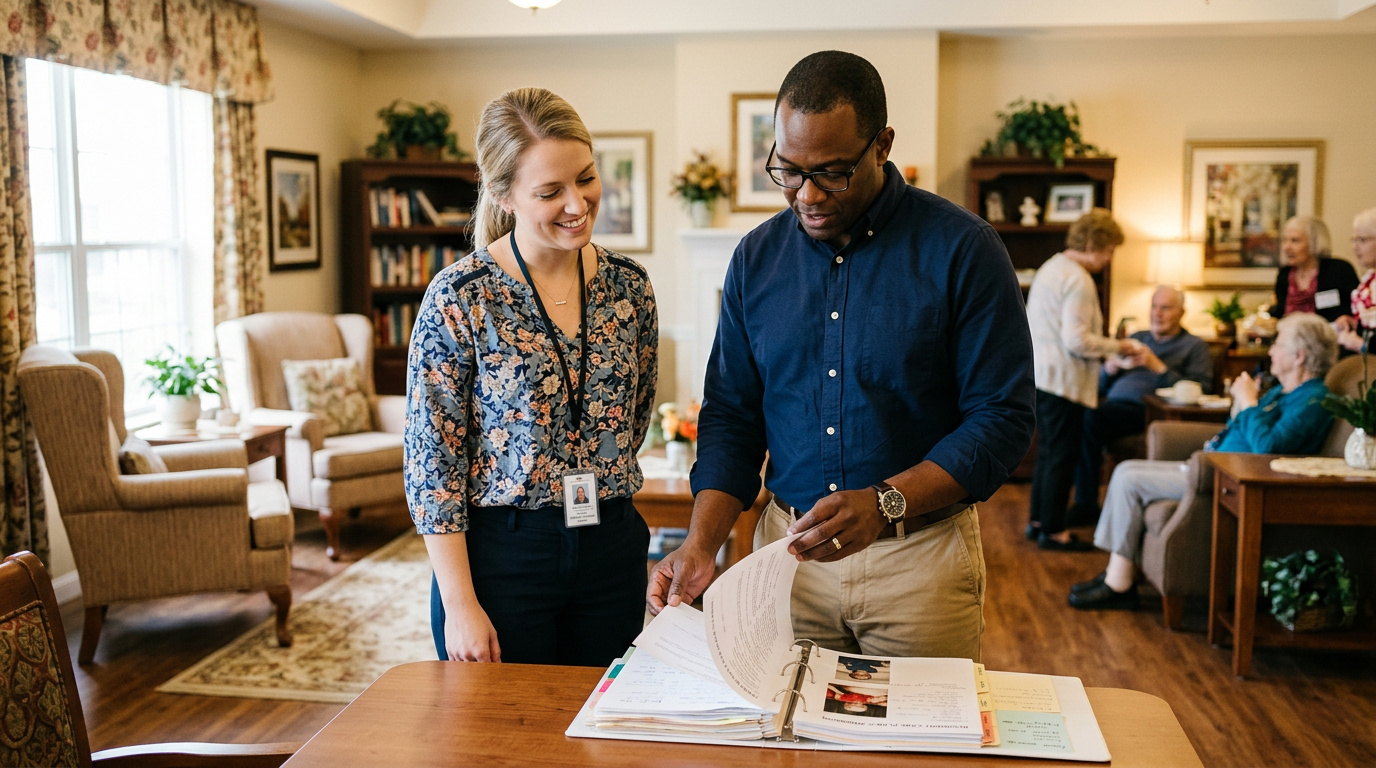
For many Activity Professionals, the mention of an upcoming survey immediately brings up thoughts about calendars, attendance records, bulletin boards, care plans, and documentation binders.
Those things matter. But under F679, surveyors are not simply looking to see whether activities happened. They are looking for evidence that residents are being supported in living meaningful, connected, person-centered lives.
That is a much bigger standard than a full activity calendar.
F679 asks activity departments to look beyond “What is on the schedule?” and begin asking, “Does this resident have opportunities for choice, purpose, independence, connection, and meaningful engagement?”
Quick Answer
What do surveyors really look for under F679?
Surveyors look for evidence that residents have meaningful opportunities for engagement based on their individual interests, preferences, abilities, choices, routines, and quality-of-life needs. A monthly calendar may support the activity program, but it does not prove F679 compliance by itself.
What Is F679?
F679 is the federal survey tag connected to activities in nursing homes and long-term care settings. In simple terms, it requires facilities to provide an ongoing activity program that supports each resident’s physical, mental, and psychosocial well-being.
But the important words are not just “activity program.” The important words are each resident.
That means the activity program should not only be built around what is easy to schedule, what staff have always done, or what looks good on a calendar. It should be connected to resident preferences, resident choice, assessed needs, abilities, interests, and quality of life.
This is why person-centered planning is so important. F679 is not just asking whether activities exist. It is asking whether those activities matter to the people living there.
The Biggest Myth About F679
One of the biggest myths in activity departments is this:
“If we have a full calendar, we are survey-ready.”
A full calendar can be helpful. It shows structure. It shows planning. It helps residents, families, and staff know what is available.
But a full calendar does not automatically prove meaningful engagement.
A facility may offer bingo, crafts, exercise, trivia, devotions, music, and socials every week and still have residents who are isolated, disengaged, overlooked, or unsupported.
That is where surveyors may look deeper.
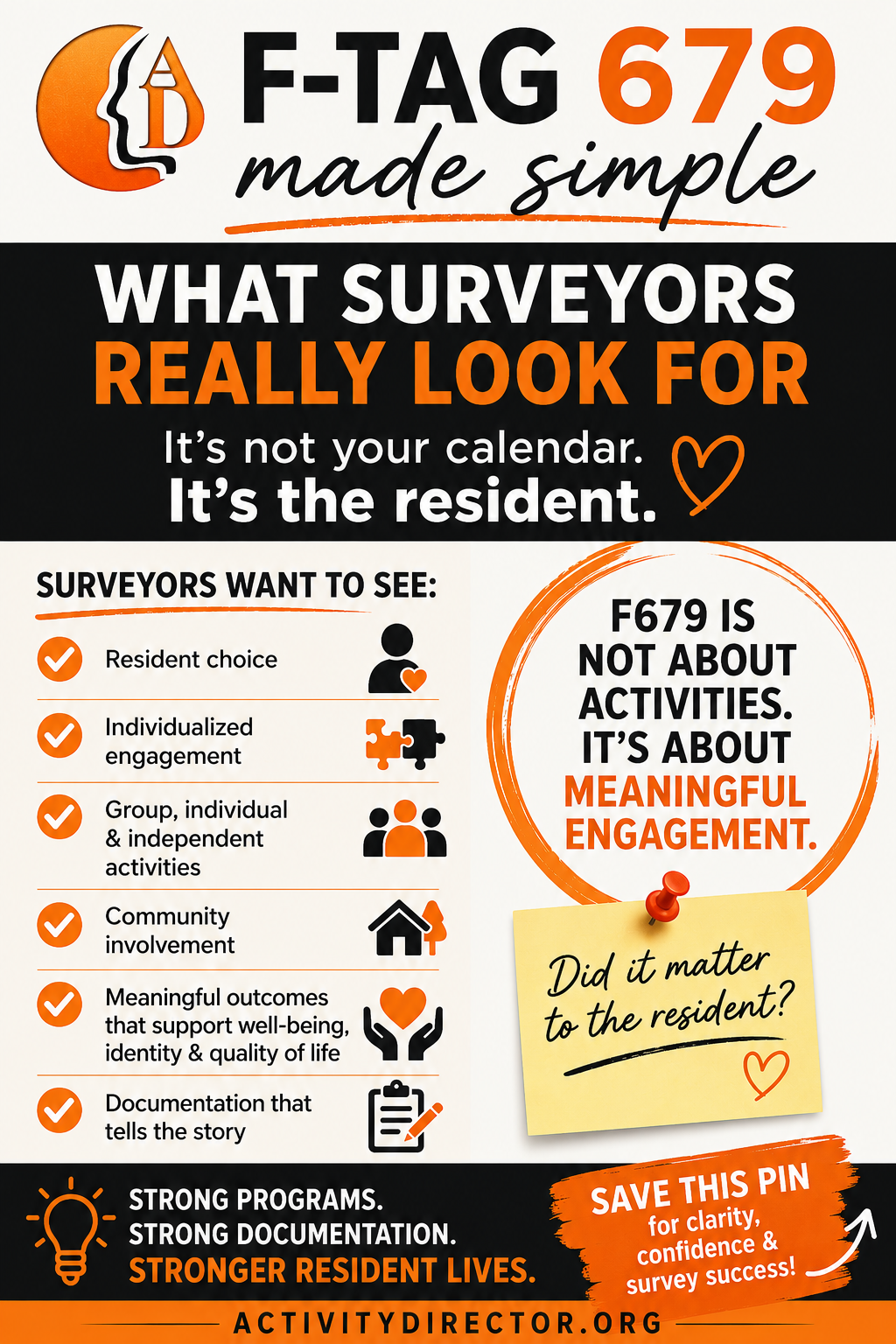
What Surveyors Actually Want to See
Under F679, surveyors may look for signs that the activity program is truly connected to resident life, not just department routines. They may look for evidence that programming supports the resident’s well-being, choices, preferences, abilities, and interests.
Resident Choice
Can residents choose activities that match their interests, routines, culture, preferences, and energy level?
Individualized Engagement
Are residents supported as individuals, including those who do not attend group activities?
Meaningful Outcomes
Does the activity program support quality of life, connection, purpose, comfort, independence, and psychosocial well-being?
Documentation Support
Do notes, assessments, care plans, and observations show what matters to the resident and how staff respond?
This is where strong activity practice moves beyond entertainment. Activity Professionals are not simply filling time. They are helping residents remain connected to identity, community, routine, purpose, and personal meaning.
For more support with this idea, read Group Activities for Seniors: Creating Meaningful Engagement and One Small Shift for More Meaningful Activities in Senior Living.
The Resident Who Never Attends Activities
One of the clearest ways to understand F679 is to think about the resident who rarely or never attends scheduled group activities.
Maybe the resident prefers quiet. Maybe they are grieving. Maybe they have always been private. Maybe they are hard of hearing, visually impaired, living with dementia, easily overstimulated, embarrassed by physical changes, or simply uninterested in traditional group programming.
A surveyor may ask:
- What does this resident enjoy?
- How do you know?
- What has the team tried?
- What does meaningful engagement look like for this person?
- Are there independent activities available?
- Are one-to-one visits documented?
- Does the care plan reflect the resident’s actual preferences?
This is why “they refuse activities” is usually not enough.
The activity department should be able to show that staff have explored preferences, offered choices, adjusted approaches, documented responses, and continued seeking meaningful ways to support the resident’s quality of life.
Calendar, Attendance, and Documentation All Tell a Story
Surveyors may review the activity calendar, but the calendar is only one piece of the story.
They may also look at:
- Activity assessments
- Care plan approaches
- Progress notes
- Attendance patterns
- Resident interviews
- Family interviews
- Observation of activities
- Room visits and one-to-one programming
- Documentation for residents who decline group activities
- Evidence of individualized interventions
These pieces should work together. If the assessment says a resident loves gardening, the care plan should reflect that. If the care plan says the resident benefits from music, the documentation should show whether music is being offered and how the resident responds.
For more help with this piece, see What Surveyors Really Look for in Activity Documentation, Activity Documentation Examples: What Good Notes Actually Look Like, and What Activity Documentation Should Say.
Person-Centered Planning Made Easy
F679 becomes much easier to understand when activity planning begins with the resident instead of the calendar.
This course helps Activity Professionals strengthen assessments, preferences, care planning, and meaningful engagement in everyday practice.
Care Plan Support
Survey Readiness
The Difference Between Busy and Engaged
One of the most important shifts for Activity Professionals is learning the difference between a resident being occupied and a resident being meaningfully engaged.
Occupied
The resident is present, seated, watching, listening, or passing time, but the activity may not connect strongly to their interests, identity, or emotional needs.
Engaged
The resident is connected in a way that supports meaning, memory, comfort, choice, expression, purpose, relationships, independence, or quality of life.
A resident sitting in the activity room is not automatically engaged. A resident quietly looking through family photos, helping fold towels, listening to familiar hymns, watering plants, sorting baseball cards, or talking about former work may be deeply engaged.
Meaningful engagement does not always look loud, social, or calendar-friendly. Sometimes it looks quiet, familiar, sensory, spiritual, practical, emotional, or deeply personal.
What F679 Looks Like Through the Eyes of a Resident
A helpful way to understand F679 is to stop reading it only as a regulation and start reading it from the resident’s point of view.
- Do people here know what I enjoy?
- Do I still have choices?
- Can I continue parts of my former routines?
- Do I have opportunities to feel useful?
- Can I connect with others in ways that feel natural to me?
- Am I supported when I do not want to attend groups?
- Can I experience the outside world?
- Does my life still feel like my life?
This is where F679 becomes more than a survey tag. It becomes a quality-of-life standard.
For related reading, see What Happens When Residents Stop Experiencing the Outside World? and Music, Memory & Meaningful Engagement.
Common F679 Mistakes Activity Departments Make
Most F679 concerns do not happen because an Activity Professional does not care. They happen because the department becomes overwhelmed, short-staffed, routine-driven, or too dependent on the calendar as proof of engagement.
Mistake 1: Treating Attendance as the Whole Story
Attendance shows participation, but it does not always show meaning, preference, response, or individualized support.
Mistake 2: Overusing Generic Activities
Generic activities may be fine for some residents, but they should not replace individualized programming based on real resident interests.
Mistake 3: Forgetting Residents Who Decline Groups
Residents who do not attend groups still need opportunities for engagement, choice, comfort, routine, and connection.
Mistake 4: Weak Care Plan Follow-Through
If the care plan lists preferences or interventions, staff should be able to show how those approaches are being used.
Mistake 5: Not Adapting for Dementia or Ability Changes
Meaningful engagement may need to be simplified, adapted, shortened, made sensory, or connected to familiar roles and routines.
For more examples of common department challenges, read Common Activity Director Mistakes and How to Pass Your Activity Department Survey.
F679 Self-Audit Checklist
Before survey, activity departments can use a simple self-audit to identify weak spots and strengthen their program.
- Can we explain how activities are based on resident preferences?
- Do assessments identify meaningful interests, routines, and past roles?
- Do care plans reflect individualized activity needs?
- Do we have support in place for residents who do not attend groups?
- Are one-to-one visits documented clearly?
- Do we offer independent activities for residents who prefer self-directed engagement?
- Do residents have opportunities for community connection?
- Can staff describe what meaningful engagement looks like for specific residents?
- Do documentation notes show resident response, not just staff action?
- Can we show that the activity program supports quality of life?
If the answer to any of these questions is unclear, that does not mean the department is failing. It means there is an opportunity to strengthen systems, documentation, and staff understanding before survey.
Documentation Example
Strong F679 documentation should show more than attendance. It should help connect the resident’s needs, preferences, interventions, and response.
Progress Note Example: Resident declined group trivia this afternoon, stating she preferred to remain in her room. Activity staff offered two individualized options based on known preferences: gospel music and sorting family recipe cards. Resident chose recipe cards, smiled while discussing favorite holiday foods, and engaged for approximately 20 minutes. Staff will continue offering quiet one-to-one activities related to homemaking, family traditions, and familiar music.
This kind of note shows choice, preference, adaptation, response, and follow-up. It also gives the care team usable information.
For more documentation support, visit Activity Documentation Examples: What Good Notes Actually Look Like.
Final Thoughts
F679 is often discussed as a survey requirement, but at its heart, it is about resident quality of life.
It asks whether residents still have opportunities to choose, connect, participate, contribute, enjoy, remember, express, belong, and experience meaning in daily life.
That is why the activity department matters so much.
A strong activity program does more than fill a calendar. It helps residents remain connected to who they are.
F679 is not just asking, “What did you do today?” It is asking, “Did it matter to the resident?”
Frequently Asked Questions
Is F679 only about the activity calendar?
No. The activity calendar is one part of the program, but F679 focuses on whether residents receive meaningful, ongoing opportunities for engagement based on their interests, choices, abilities, and well-being.
Can a resident refuse activities?
Yes. Residents have the right to refuse activities. However, the facility should still explore preferences, offer alternatives, support choice, and document individualized approaches when appropriate.
Do one-to-one visits matter under F679?
Yes. One-to-one programming can be especially important for residents who do not attend groups, prefer quiet engagement, have dementia, are room-bound, or need individualized support.
What should F679 documentation show?
Documentation should show resident preferences, interventions offered, resident choices, responses, adaptations, and follow-up when needed. Strong notes help connect the activity program to the resident’s quality of life.
Why is meaningful engagement important for survey readiness?
Meaningful engagement helps demonstrate that the activity program is not simply routine entertainment, but a person-centered service that supports physical, mental, psychosocial, emotional, and social well-being.



Keep Exploring Survey Readiness Resources
Continue building stronger F679 support, documentation confidence, and person-centered activity programming with these related Activity Directors Network resources: