
If you’ve ever stared at a blank note and thought, “What am I supposed to write here?” you’re not alone and you’re not doing anything wrong. You were just never shown a clear, workable way to document like an activity professional. Let’s talk about the moment almost everyone has, usually at the end of a long day. You open a progress note, your brain goes quiet, and you can feel the pressure rising: “I know what happened… but what do they want me to say?”
That moment doesn’t mean you’re unprepared. It usually means expectations have been vague for a long time. Most activity professionals are handed a charting system, told to “document participation,”
and then left to guess what that should sound like. Over time, guessing turns into second-guessing — especially when survey season gets close, or when someone asks you to explain a note you wrote months ago.
Here’s the reassuring truth: activity documentation was never meant to feel like a performance. It’s meant to feel like clear communication.
The shift that changes everything is this:
activity documentation is professional communication — not a clinical record.
You are not diagnosing. You are not writing therapy notes. You are simply communicating what was offered, how participation occurred, and how the resident responded, so the note makes sense even when you aren’t there to explain it.
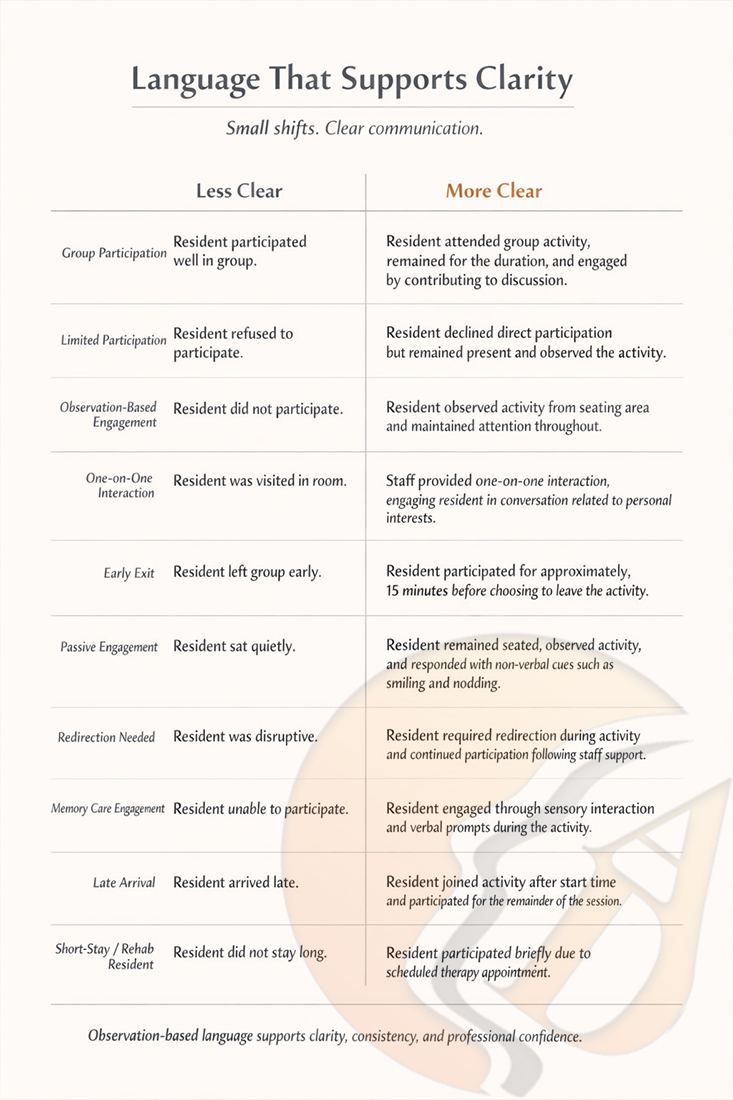
A lot of professionals get tripped up because they feel pressure to sound “clinical” to be taken seriously.
And once you start reaching for language that doesn’t match your scope, the whole thing gets harder.
You can feel it — the note stops sounding like you, and you start worrying you’ll say too much, or not enough, or the wrong thing.
What we want instead is grounded, observable charting that respects resident choice and clearly reflects participation. That includes listening, observing, responding non-verbally, or remaining present —
even when participation doesn’t look “active” on the surface.
When charting is written with clarity instead of fear, notes start holding up over time. They don’t require a verbal footnote later. They don’t rely on memory. They read like a calm, consistent record of meaningful engagement.
If your notes feel “fine” but still make you uneasy…
That’s usually the sign your documentation system needs support, not that you do. The goal is simple: when someone reads your note later, it should make sense on its own — without translation.
This is why Charting With Confidence exists. Not to turn charting into a rulebook. Not to scare you with survey stories. And definitely not to make documentation more complicated than it needs to be.
Once the purpose clicks, the second-guessing fades. The notes get easier. And confidence starts to feel like your default again.

Ready to stop guessing?
If you’ve ever searched “what should activity documentation say?” you’re in the right place.
You don’t need perfect wording. You need clarity.
Explore ADN Programs & Resources

NAPT100 Course
10 Weeks / 100 Hours
Our 100-hour APNCC-approved course prepares you for National Board Certification and a rewarding new career.

The Activity Store
Forms, packs, and resources
Calendars, documentation, participation tools, and resources designed to save time and support survey-ready practices.

CE Courses
APNCC Approved
Affordable live and self-paced CE classes to meet renewal requirements and grow your professional skills.

Calendar Club
Calendar & Newsletter Templates
Subscribe monthly or annually for editable calendars, newsletters, forms, and activity ideas that save you time.