The Activity Calendar Is Not the Activity Program
A practical 10-minute F679 and F680 self-audit to see whether your activity program reaches beyond the calendar and back to the individual resident.
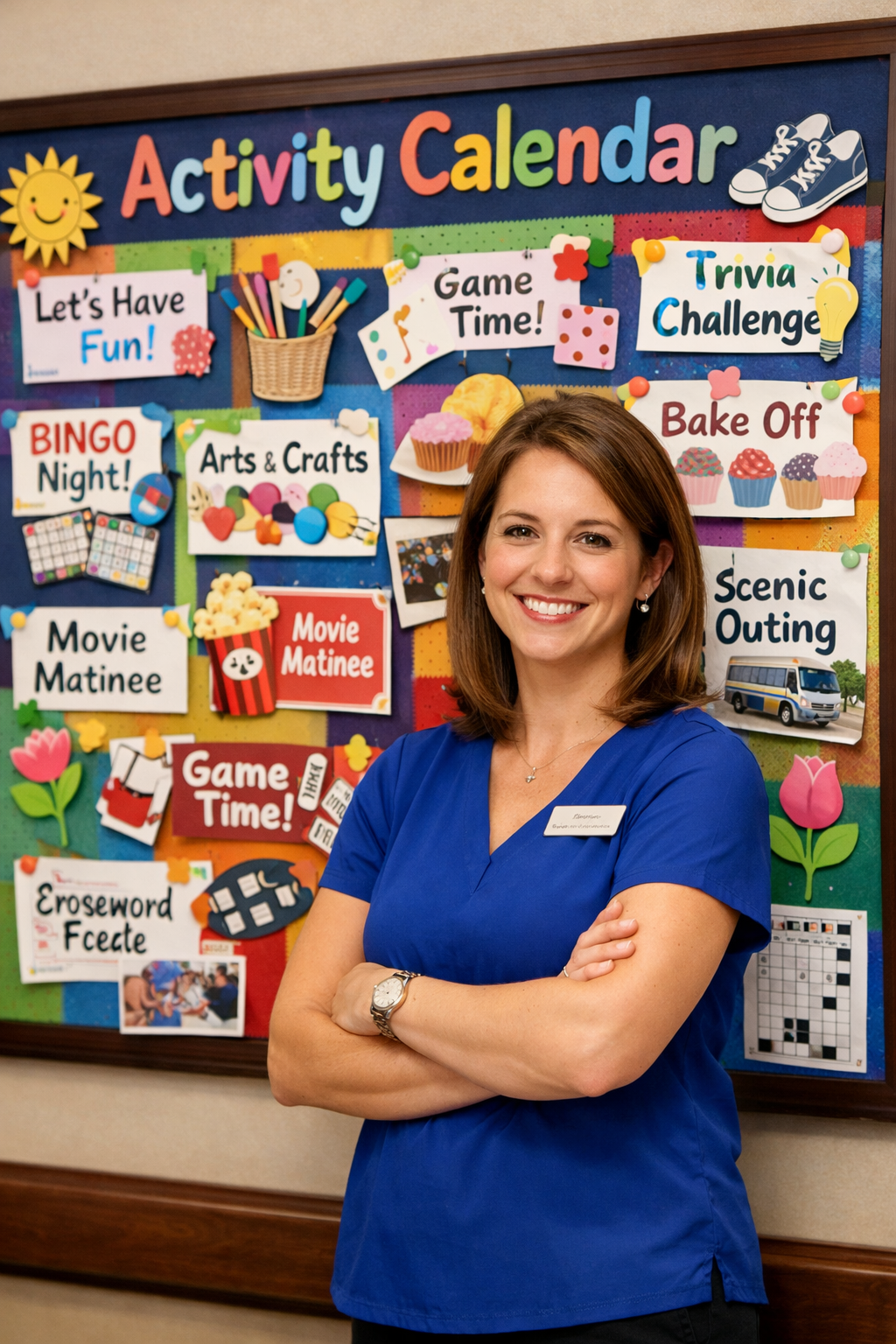
Most Activity Departments can point to the monthly calendar immediately.
There are groups. Entertainment. Exercise. Crafts. Special events. Maybe a few outings and holiday programs squeezed into an already crowded month.
But a full calendar does not automatically mean the facility has a strong activity program.
Federal nursing-home guidance looks beyond the number of activities scheduled. Under F679, the program is expected to connect back to each resident’s comprehensive assessment, care plan, interests, preferences, choices, and physical, mental, and psychosocial well-being.
Quick Answer: Your calendar shows what the department scheduled. Your activity program should show how residents are being supported as individuals—including people who participate in groups, people who prefer one-to-one engagement, and people who pursue meaningful activities independently.
That difference is worth checking before surveyors—or anyone else—start asking questions.
F679 in Plain Language
F679 is tied to §483.24(c)(1). The regulation requires an ongoing activity program based on the resident’s comprehensive assessment, care plan, and preferences.
It specifically includes opportunities for facility-sponsored group activities, individual activities, and independent activities.
The goal is not simply participation. The program should meet resident interests and support physical, mental, and psychosocial well-being while encouraging independence and interaction in the community.
CMS guidance even recognizes that some nursing homes may not use a traditional activity calendar at all. Resident-directed daily life, spontaneous activities, independent pursuits, chores, social interaction, and activities supported by staff throughout the facility may all contribute to the overall program.
That makes the real question much bigger than, “How many activities did we schedule?”
The better question is: “Can we show how the program reflects the people who actually live here?”
Related reading:
What Surveyors Really Look For Under FTag679
Start With the Three-Resident Test
You do not need to audit the entire building to learn something useful about your program.
Choose three residents:
Resident One
Someone who regularly attends scheduled group activities.
Resident Two
Someone who participates occasionally or selectively.
Resident Three
Someone you rarely see at a scheduled group activity.
Now walk through the following questions for each person.
Why Include a Nonparticipant?
Residents who do not attend groups often tell you the most about whether your department has built a true activity program or simply a group-activity schedule.
1. Can You Tell What Actually Matters to This Resident?
Start with the activity assessment.
If another member of the team opened the record, could that person understand something meaningful about the resident’s interests, former roles, routines, abilities, preferences, cultural background, strengths, goals, and patterns of activity?
Or does the assessment mostly say:
Likes music, TV, bingo and socializing.
Those may all be accurate, but they do not tell the team very much about the person.
CMS guidance describes the activity assessment broadly enough to include lifelong interests, spirituality, previous life roles, goals, strengths, needs, activity patterns, and preferences.
Useful information gives the department somewhere to go.
2. Does the Care Plan Connect to What the Assessment Says?
The activity assessment, care plan, and actual programming should tell the same basic story.
If gardening, woodworking, grandchildren, cooking, church, country music, animals, reading the newspaper, baseball, sewing, solitude, or outdoor time is important to the resident, there should be a logical connection between that information and the approaches being used.
Weak Connection
Resident enjoys individualized leisure activities. Encourage attendance at activities of choice.
Stronger Connection
Resident prefers quiet morning routines, gardening, country music and small-group conversation. Offer access to courtyard gardening, personal music selections and smaller social programs.
Related reading:
What Is Person-Centered Planning?
3. Does the Resident Have Meaningful Choices Beyond Group Activities?
This is where many otherwise busy departments discover a gap.
For each of your three residents, identify something meaningful in all three areas:
Group
A facility-sponsored activity the resident genuinely enjoys or chooses.
Individual
An individualized opportunity supported by staff when appropriate.
Independent
Something the resident can pursue without waiting for a scheduled group.
A resident who dislikes groups should not become invisible to the Activity Department because they do not appear on the attendance sheet.
4. Are You Documenting More Than Attendance?
Attendance can tell you that a resident was present.
It does not automatically tell you whether the program met that resident’s needs.
Look for useful observations:
- Did the resident participate?
- Observe quietly?
- Initiate conversation?
- Smile or laugh?
- Become restless?
- Leave early?
- Decline?
- Request the activity again?
- Prefer a different approach?
The resident’s response helps show whether an approach is actually working—and gives the team information to use the next time.
Related reading:
Activity Documentation Examples: What Good Notes Actually Look Like
Want to Look at the Rest of Your Department Through a Survey Lens?
Once you finish this three-resident check, take the next step with our broader guide to activity-department survey readiness.
Read: How to Pass Your Activity Department Survey5. Can the Resident Do Something Meaningful Without Waiting for You?
Think beyond the calendar.
Depending on the person, independent opportunities might include books, newspapers, cards, puzzles, music, crafts, gardening, religious materials, correspondence, hobbies, photographs, television programs, audiobooks, technology, outdoor access, collections, handwork, or another familiar interest.
Some residents may need supplies set up. Others may need reminders, adaptive equipment, transportation to a common area, or help accessing a device.
Others may be completely independent once the opportunity is available.
A Useful Mindset Shift
Meaningful activity does not have to begin when an Activity Professional enters the room.
6. If the Resident Rarely Participates, Do You Know Why?
“Does not attend activities” is not always the end of the story.
A resident may avoid scheduled programming because the programs do not fit the person’s preferences, energy level, schedule, abilities, sensory needs, social comfort, or former lifestyle.
- Maybe the resident dislikes large groups.
- Maybe mornings are better than afternoons.
- Maybe hearing or vision creates a barrier.
- Maybe the resident enjoys observing but not actively participating.
- Maybe former hobbies are missing from the program.
- Maybe one-to-one interaction is more comfortable.
- Maybe the resident enjoys independent pursuits.
- Maybe the resident simply does not like the activities being offered.
7. Can You Show That the Program Changes When the Resident Changes?
An ongoing program should actually be ongoing.
CMS guidance describes directing the activity program as including monitoring resident responses, reviewing or evaluating whether programs meet assessed needs, and making revisions when necessary.
Look again at your three residents.
Can you identify something the department learned and then changed?
You Learned
Large groups overwhelm the resident.
You Adjusted
The resident now receives invitations to smaller programs and individualized options.
If every approach looks exactly the same month after month despite changes in condition, ability, interests, routine, or response, take a closer look.
8. Can You Verify the Activity Professional’s Qualifications?
F679 focuses on whether the activity program meets resident interests and needs. F680 focuses on whether that program is being directed by a qualified professional.
Under §483.24(c)(2), the professional must be licensed or registered if applicable in the state and meet at least one of the qualification pathways listed in the regulation, such as eligibility for certification by a recognized accrediting body, specified experience, qualifying occupational-therapy credentials, or completion of a state-approved training course.
Important: CMS describes F680 as an absolute tag. If the facility does not meet the qualification requirement, the tag may be cited even when there has not been a negative resident outcome.
Do Not Wait Until Survey Morning to Find the Qualification File
The facility should know which regulatory pathway applies to the person directing the activity program and be able to locate documentation supporting that pathway.
That may involve documentation of applicable licensure or registration, certification eligibility, employment experience, qualifying occupational-therapy credentials, state-approved training, or other records appropriate to the pathway being used.
Department Check: If the administrator asked you right now, “Show me the documentation that establishes why our Activity Director meets §483.24(c)(2),” how quickly could the facility produce it?
Remember that federal requirements are only part of the picture. Facilities should also verify any applicable state requirements.
What Did Your Three Residents Reveal?
This is not an official CMS scoring tool and there is no magic number of boxes you need to check.
The purpose is simpler: use three real residents to expose places where the department’s systems may not match its intentions.
You may discover a need for:
- more individualized activity assessments;
- stronger care-plan connections;
- better one-to-one programming;
- more independent activity options;
- clearer documentation of resident response;
- better follow-up when residents decline;
- more communication with nursing, social services, therapy, dietary, and other departments;
- or better organization of qualification records.
Those are useful findings.
Finding a weak spot yourself gives you an opportunity to improve the program before it becomes somebody else’s finding.
The Calendar Is a Tool. The Resident Is the Program.
Activity Professionals spend an enormous amount of time managing calendars, entertainers, decorations, supplies, volunteers, documentation, meetings, outings, special events, room visits, and last-minute changes.
All of that work can make the calendar feel like the center of the department.
But CMS guidance describes a much bigger purpose: an activity program supporting resident well-being, independence, interests, preferences, choice, identity, connection, joy, and meaning.
The activity program should tell you something about the people who live there.
When assessments, care plans, programming, observation, documentation, and resident response all connect, the department becomes much easier to explain—because the resident’s story is visible throughout the process.
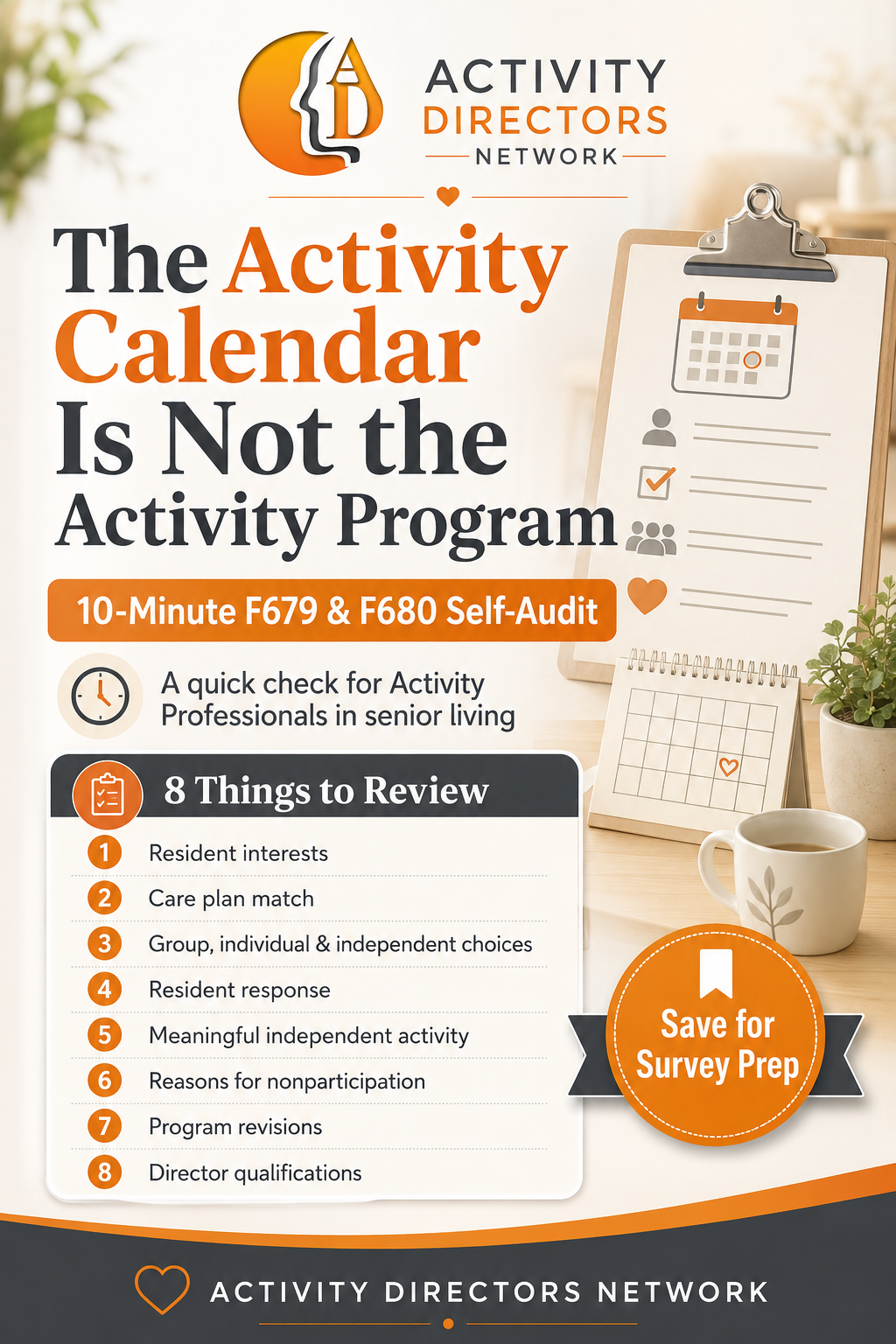
Keep the 10-Minute Self-Audit Handy
Save or pin this quick-reference version of the F679 & F680 self-audit for your next department review, staff meeting, or survey-prep day.


Frequently Asked Questions
What is F679 in a nursing home?
F679 relates to the facility’s requirement to provide an ongoing resident-centered activity program based on each resident’s comprehensive assessment, care plan, interests, preferences, and choices. The program includes group, individual, and independent activities.
What is the difference between F679 and F680?
F679 focuses on whether the activity program meets resident interests and needs. F680 focuses on whether the program is directed by a qualified professional who meets the requirements of §483.24(c)(2).
Does F679 require every resident to attend group activities?
No. The regulation supports resident choice and specifically recognizes group, individual, and independent activities. A resident’s preferences and assessed needs should guide the approach.
Is an activity calendar enough to demonstrate F679 compliance?
A calendar may show part of the facility’s programming, but the broader requirement connects activities with each resident’s assessment, care plan, preferences, choices, interests, and well-being. CMS guidance also recognizes nontraditional and independent approaches to activity programming.
Is F680 really an absolute tag?
Yes. Current CMS Appendix PP guidance describes F680 as an absolute tag, meaning the facility must have a qualified professional directing the activity program. CMS notes that the tag may be cited for noncompliance regardless of whether negative resident outcomes have occurred.
Sources and Further Reading
- CMS State Operations Manual, Appendix PP — F679 & F680
- 42 CFR §483.24 — Quality of Life and Activities
- CMS Nursing Home Survey Guidance and Resources
This article is provided for professional education and general informational purposes. Facilities should review current federal guidance, applicable state requirements, facility policy, and professional compliance guidance when evaluating regulatory compliance.