
Resolving Resident Conflict: Understanding Combative Behavior
A practical look at why combative behavior may occur in long-term care settings — and how activity professionals and care teams can begin responding with awareness, dignity, and prevention in mind.
Original article by Celeste Chase · Updated by Activity Directors Network

Author Credit: This article is based on the original work of Celeste Chase for Activity Directors Network’s Consultant’s Help Desk series. It has been updated and reformatted by Activity Directors Network to fit today’s person-centered activity programming, care team support, and blog format.
Residents in long-term care may experience chronic cognitive impairment, confusion, communication difficulty, or emotional distress that can sometimes appear as combative behavior. When this happens, it is important for care professionals to remember that the behavior is often not personal. It may be the resident’s attempt to communicate fear, discomfort, confusion, frustration, pain, or an unmet need.
The goal is not simply to “stop” a behavior. The goal is to understand what may be happening beneath the behavior so the team can respond with safety, respect, and prevention in mind. Strong person-centered planning often helps teams understand the individual behind the behavior rather than only reacting to the behavior itself.
Quick Answer
What causes combative behavior in long-term care?
Combative behavior in long-term care may be a form of communication. It can be connected to confusion, environmental stress, dementia, pain, loss of control, rushed caregiving, unmet needs, or difficulty processing information.
Behavior Is Often Communication
Communication issues can occur when a resident has limited receptive abilities, meaning they may have difficulty understanding what is being said or what is happening around them. Reduced information processing speed and capacity can make even simple instructions feel overwhelming.
Aging adults may also have difficulty expressing themselves clearly. A resident may know they are uncomfortable, afraid, embarrassed, or upset, but may not be able to organize those feelings into words that staff can easily understand.
This is why prevention matters. When healthcare professionals assess, understand, and take action before a situation escalates, they can reduce communication breakdowns and help the resident feel safer during care.
Common Forms of Combative Behavior
Physical Acts
Hitting, kicking, fighting, or other actions that may endanger others, objects, or the resident.
Resisting Care
Aggressively resisting assistance with ADLs such as bathing, dressing, grooming, or personal care.
Verbal Aggression
Arguing, cursing, threatening, accusing, or other verbal signs of distress or fear.
Catastrophic Reactions
Sudden outbursts, emotional overwhelm, mood shifts, or loss of self-control.
What May Cause Combative Behavior?
Combative behavior can have many causes. Looking only at the behavior itself may cause staff to miss what the resident is trying to communicate. A better approach is to look at the physical, emotional, environmental, cognitive, and caregiving factors that may be contributing to the situation.
Psycho-Social Factors
A resident may feel threatened by life changes, loss of control, confusion, or inability to communicate clearly. Emotional history and prior experiences can sometimes affect present behavior. Recognizing missed signs of trauma in senior care may help teams better understand resident responses.
Environmental Factors
Lighting that is too bright or too dim, loud televisions, radios, intercom announcements, clutter, constant staff traffic, unexpected room changes, or changes in routine may all contribute to agitation.
Dementia
Dementia can affect memory, personality, perception, communication, and understanding, making the world feel confusing or frightening. Environmental support, sensory support, and individualized approaches can often reduce distress. Visual approaches may also help; see Visual Stimulation for Alzheimer’s Disease and Dementia.
Caregiving Approach
Staff may unintentionally contribute to agitation when care feels rushed, rough, impatient, authoritative, loud, or startling. A resident may respond defensively when they feel surprised, cornered, corrected, or controlled.
Underlying Illness or Discomfort
A comprehensive assessment is important. Pain, infection, medication interactions, lack of sleep, substance use, dehydration, constipation, anxiety, or other medical concerns may contribute to aggressive or resistant behavior.

The Activity Directors Bible
A complete operational guide for Activity Professionals who want stronger systems, better documentation, and more confidence in daily practice.
Built to help you organize your department, support survey readiness, and stop reinventing everything from scratch.
Care Plan Support
Policies & Procedures
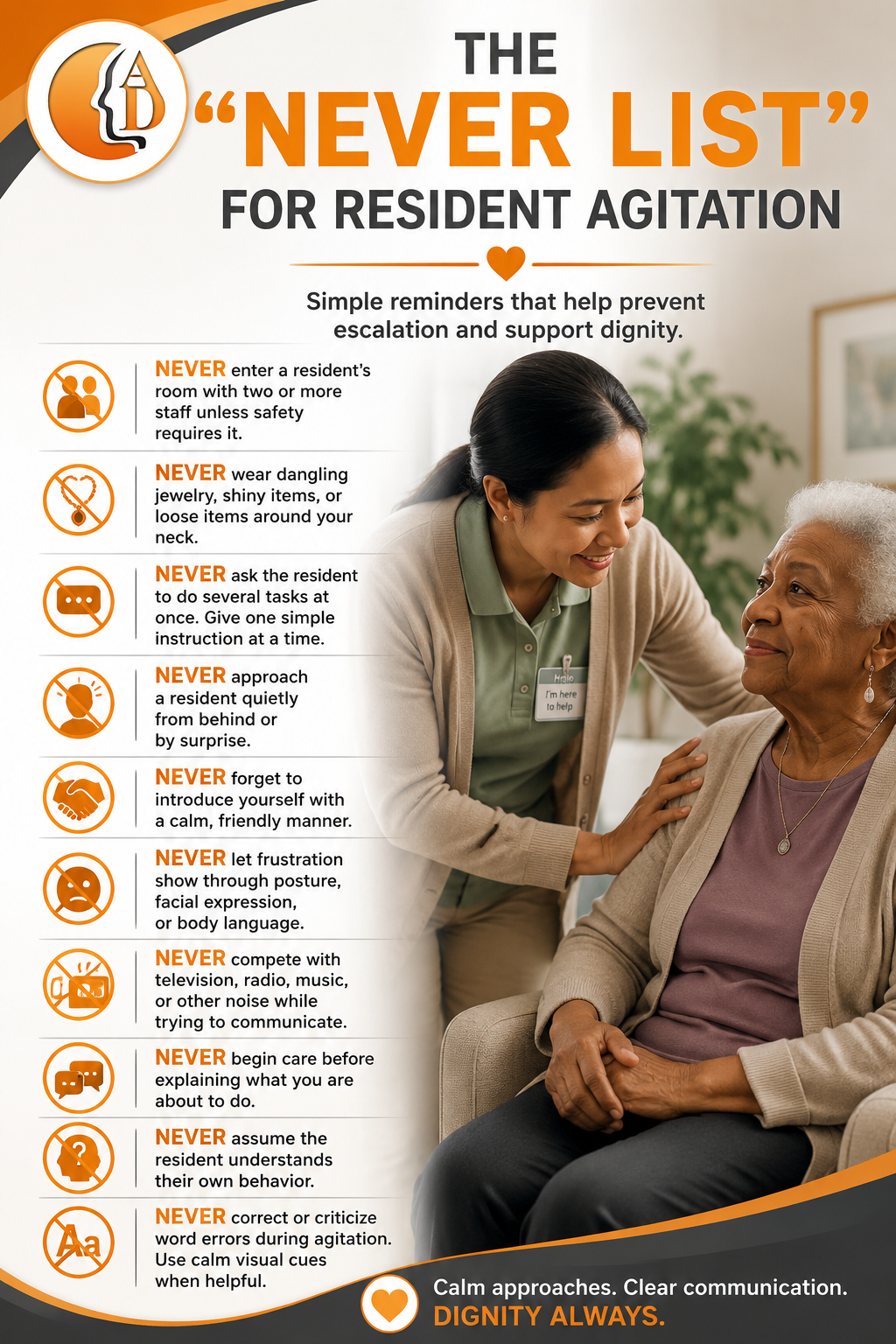
The “Never List” for Resident Agitation
When a resident is agitated, the care team’s approach can either reduce distress or increase it. The following reminders are simple, practical ways to avoid unintentionally escalating a resident who is already overwhelmed.
- Never enter a resident’s room with two or more staff members unless safety requires it. Too many people may make the resident feel defensive.
- Never wear dangling jewelry, shiny items, or loose items around your neck that could become a safety risk.
- Never ask the resident to do several tasks at once. Give one simple instruction at a time.
- Never approach a resident quietly from behind or by surprise. Allow the resident to see you coming.
- Never forget to introduce yourself with a calm, friendly manner, even if the resident knows you.
- Never let frustration show through posture, facial expression, or body language.
- Never compete with television, radio, music, or other noise while trying to communicate.
- Never begin care before explaining what you are about to do in simple terms.
- Never assume the resident understands their own behavior. They may be just as confused or surprised as staff.
- Never correct or criticize word errors during agitation. Use calm visual cues when helpful.
Words That May Escalate the Situation
Direct commands may feel natural in the moment, especially when safety is a concern. However, when a resident is already agitated, sharp command statements can sometimes escalate fear, resistance, or defensiveness.
Avoid command phrases such as:
- No — stop that
- Don’t do this
- Don’t do that
- Put it down now
- Leave it alone
- Stop getting up
Instead, use calm redirection, reassurance, simple explanation, and environmental awareness whenever possible. The goal is not to win a power struggle. The goal is to reduce fear and restore safety.
Documentation Example
Progress Note Example: Resident became visibly agitated during morning care and resisted assistance with dressing. Staff reduced stimulation, spoke calmly, explained each step before proceeding, and allowed resident time to respond. Resident accepted care after a brief pause and reassurance. Team will continue observing possible triggers including noise level, timing of care, and approach style.
Clear documentation helps the team see patterns over time, communicate interventions, and support survey readiness. For more support with wording, see What Activity Documentation Should Say.
Final Thoughts
It is impossible to anticipate every interaction between residents, staff, and the environment. But every facility can prepare staff to respond to difficult interpersonal and behavioral situations with skill, calm, and respect.
When aggressive behavior is misunderstood or mishandled, it can affect the resident, staff, families, and the wider community. But when behavior is approached as communication, conflict can often be reduced, safety can be restored, and the resident’s dignity can remain at the center of care.
Behavior is often asking us to listen differently.
Frequently Asked Questions
Is combative behavior always intentional?
No. In long-term care, combative behavior may be connected to confusion, fear, pain, unmet needs, dementia, environmental stress, or communication difficulty.
What should staff look for first?
Staff should look for possible triggers, including noise, lighting, rushed care, pain, fatigue, routine changes, unmet needs, or confusion about what is happening.
Why does approach matter so much?
A calm, respectful approach can reduce fear and defensiveness. A rushed, loud, controlling, or surprising approach may increase agitation.
Should behavior concerns be documented?
Yes. Documentation should include what happened, possible triggers, interventions used, the resident’s response, and any follow-up observations needed.






Keep Exploring Resident Support Resources
Continue building stronger, more person-centered support with these related Activity Directors Network resources: