
The Edges of the Bell Curve
A Resident’s View of Who Activity Programming Leaves Out
Nursing Home Resident • Activities Committee Chair • Resident Advocate
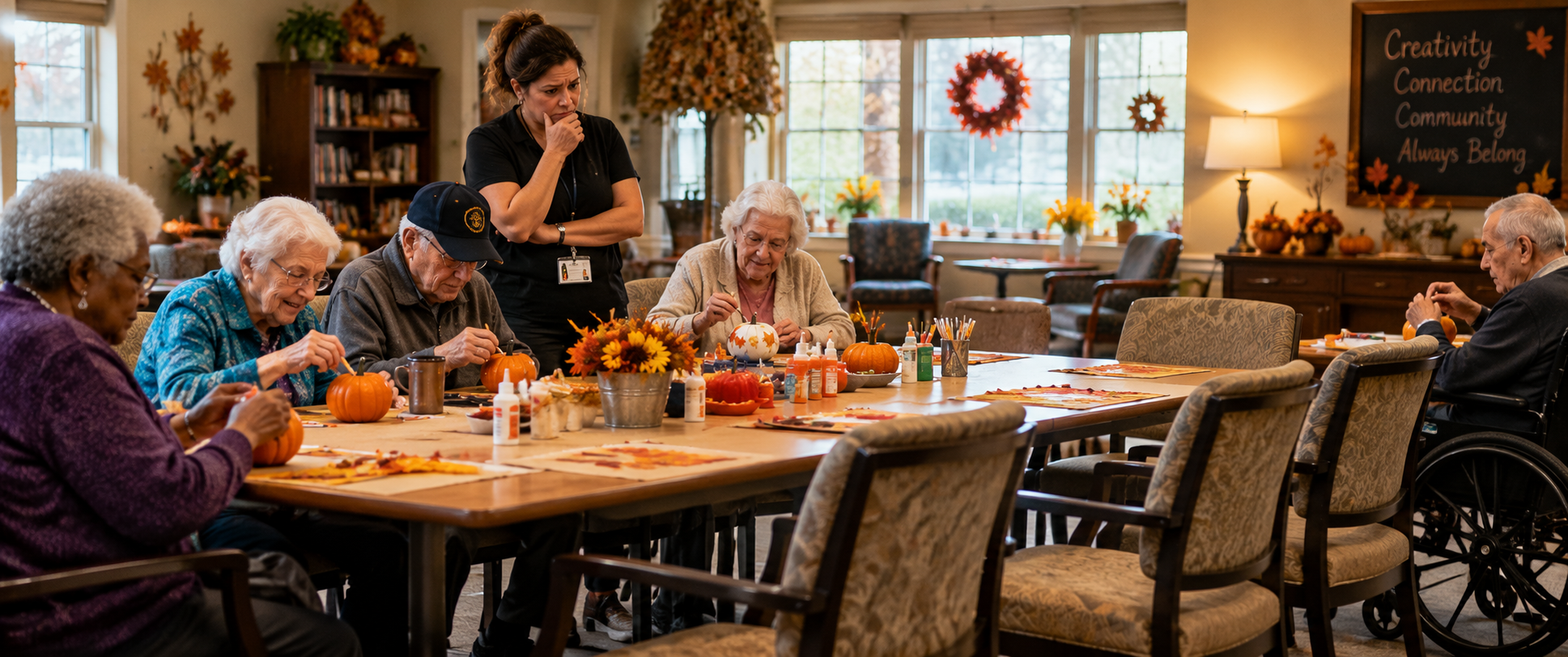
We’re pleased to welcome Doug Geiger as a guest contributor to the Activity Corner. Doug has lived in a nursing home since 2023 and chairs his facility’s Activities Committee. His first article challenges us to examine the residents who disappear from our attendance sheets and what we can do differently.
Written by Doug Geiger (Doug Myself Out)
I Live on the Edge of the Curve
Being alert times four in a nursing home can be a very lonely experience. I know who I am, where I am, when it is, and what is happening. When you are like me, you relate more to the staff than you do to your fellow residents. Despite your best efforts, there is a yawning gap of life experience and ability between a 46-year-old and an 86-year-old.
I use a power wheelchair full time and can’t transfer out of it, but my mind is fully intact. Many of our events catered to older women. The calendar was filled with bingo, tea parties, and simple games, and I felt like an adult in a kids’ classroom. I went months at a time without attending a single event.
I wasn’t the only one missing from that calendar. Residents who are bedbound weren’t on it either, for the opposite reason.
The Curve Every Calendar Is Drawn On
Picture every resident in your building placed on a bell curve by ability and interest. Most sit in the middle. Calendars aim there for good reasons: the middle fills the room, one staff member can run it, and attendance is easy to count.
The trouble is that the edges cost more per person, and nothing on the attendance sheet shows they’re missing. An empty chair looks like a choice.
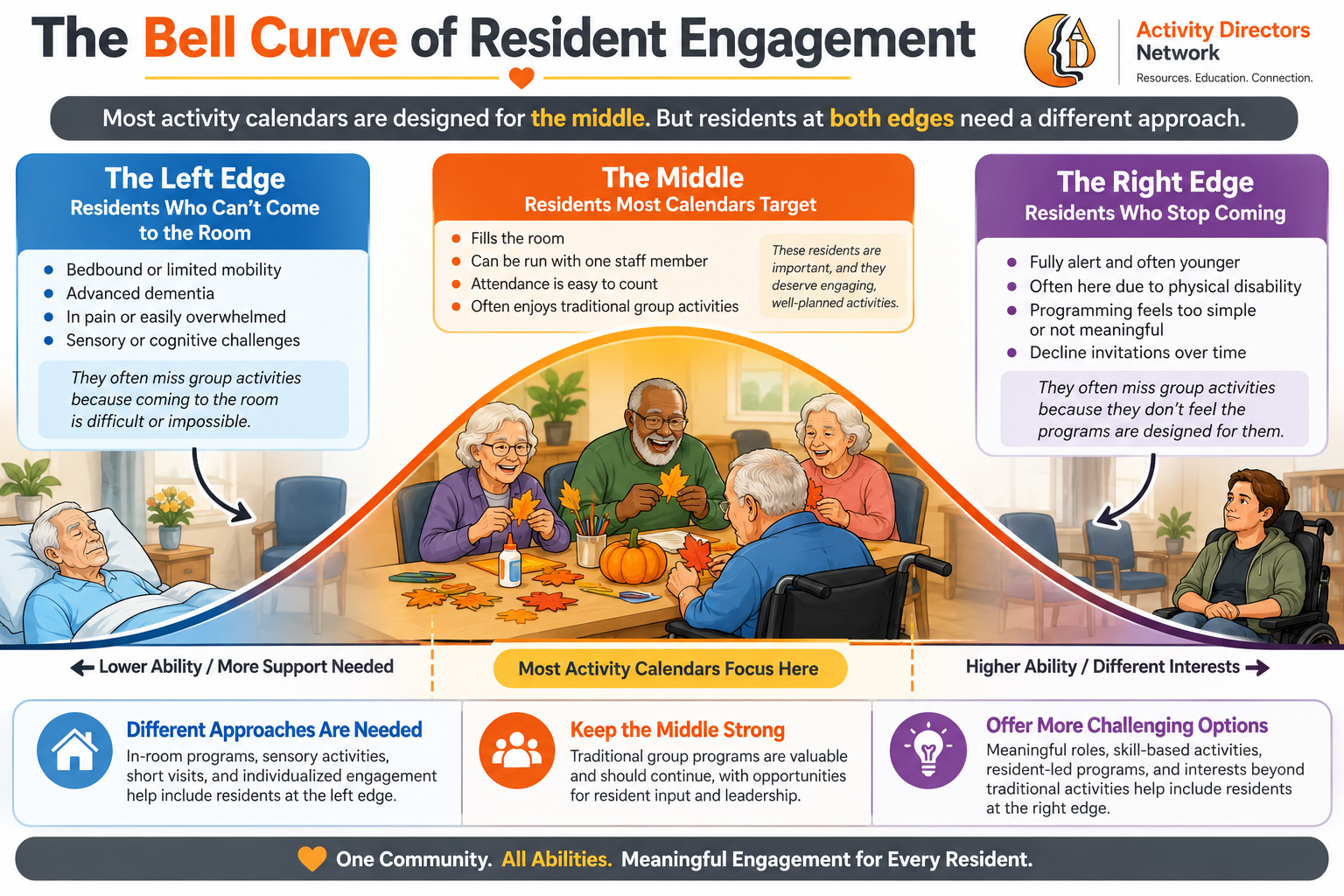
The Left Edge: Residents Who Can’t Come to the Room
These are residents who are bedbound, living with advanced dementia, in pain, or overwhelmed by a crowded room. For them, an activity often shrinks to a quick doorway visit that gets checked off as one-to-one engagement. Their days are the longest in the building.
I know a man who has lived here for about three years. He is nonverbal and doesn’t take part in many of our activities. There is nothing on his walls except one picture of a relative, kept in a protective sleeve and pinned to his bulletin board. And he isn’t the furthest out on the curve. Some residents never leave their rooms at all, for one reason or another.
On paper, he and I might look the same: residents who don’t come to activities. We got there from opposite sides of the curve.
The Right Edge: Residents Who Stop Coming
These are residents who are fully alert, often younger, and often here because of a physical disability rather than a cognitive one. When programming is pitched below them, it reads as a message about who the building thinks they are. So they decline, and the chart says “refused” or “not interested.”
Boredom gets recorded as refusal. Notice that it’s the same symptom as the left edge: an empty chair.
What We’re Doing About It
At my facility, we’re trying four things.
1. Residents help plan. Eventually our Activities Director and I connected and founded an Activities Committee, which I chair. Residents now sit at the planning table every week.
2. Capable residents get roles, not just seats. Host, scorekeeper, greeter, teacher, planner. My own role is now closer to a trustee’s. It uses my background in business ownership, technical writing, and project management, and planning scratches an itch the bingo table never could.
3. Every event has a way in for people who can’t come. We now plan for bedbound residents on purpose. For our Halloween party, treat packages go to residents who can’t attend.
4. One activity, three ways. Our pretend cider mill visit has a group version in the courtyard, an in-room version (cider, a donut, a small pumpkin), and a leadership version where a resident helps plan the decorations.
None of this costs much. Mostly it adds one question at planning time: who will this miss?
What You Can Do Monday
1. Pull two weeks of attendance and circle who isn’t on it.
2. For each name, ask: can’t come, or won’t come?
3. Pick one upcoming event and add an in-room version and a resident leadership role.
4. Ask one capable resident to help plan next month.
The companion pack has a one-page tool for each of these steps.
The Edges Tell the Truth
The middle of the curve will always be served, because it’s the easiest group to serve. F679 already asks us to go further: activities “designed to meet the interests of and support the physical, mental, and psychosocial well-being of each resident.” The edges are where we find out whether a program is built for residents or for the calendar.

Four Practical Tools for Reaching Residents at the Edges
Doug has created a free four-tool companion packet to help activity departments identify residents who are missing from programming, adapt existing activities, offer meaningful resident roles, and develop in-room participation opportunities.
Presented with an ADN how-to-use guide. Original tools by Doug Geiger.
Download the Free Companion Packet →
Free resource • CC BY 4.0 • Attribution to Doug Geiger required

Article Attribution:
The Edges of the Bell Curve by Doug Geiger
(Doug Myself Out).
Licensed under
CC BY 4.0.
Reproduced with original wording and ADN editorial formatting.
Reuse permitted with attribution, license link, and indication of changes.