Unique July Activity Ideas
for Senior Living
July programming does not have to be limited to patriotic crafts, ice cream socials, and cookouts. With a more creative approach, July can become a month of memory, comfort, storytelling, sensory engagement, and meaningful resident connection.
July activity calendars often start to look the same.
Red, white, and blue crafts. Watermelon. Patriotic trivia. Ice cream socials. Lemonade. Cookouts. Summer bingo. Fourth of July decorations.
Those activities can absolutely have a place, especially when residents enjoy them. But when every July calendar looks almost identical, the month can start to feel more like a repeat than a fresh opportunity for engagement.
July has much more to offer.
For many residents, July may bring back memories of porches, screen doors, baseball games, summer jobs, roadside produce stands, church picnics, county fairs, swimming holes, fishing trips, thunderstorms, paper fans, family reunions, road trips, lake days, fireflies, and sitting outside after supper.
Those memories are rich programming material.
The goal is not just to plan July activities. The goal is to help residents feel connected to July again.
Quick Answer: Unique July activity ideas for senior living include porch storytelling, summer object displays, indoor adventure stations, postcard projects, sensory cooling programs, resident summer job stories, sound-based reminiscence, shade mapping, oddities fairs, and memory-based food programs. The strongest July programs connect the season to resident identity, life history, comfort, and choice.
A Better July Calendar Starts with Resident Memory
It is easy to plan July around holidays, weather, and seasonal foods.
But more meaningful programming starts with a different question:
What does July mean to the people who live here?
For one resident, July may mean family reunions and homemade ice cream.
For another, it may mean long workdays in the garden or fields.
For another, it may mean fishing before sunrise, listening to baseball on the radio, working a summer job, traveling with children, watching fireworks from the porch, or trying to sleep in a hot house before air conditioning.
When Activity Professionals connect July programs to those memories, the activity becomes more than a calendar filler.
It becomes a doorway back to identity, conversation, emotional connection, and quality of life.
1. Create a July Memory Map
Instead of starting with a list of activities, start with a visual map of what July means to residents.
Place a large poster board, bulletin board, or hallway display where residents, staff, and families can add July memories throughout the month.
Possible sections could include:
- July foods
- summer jobs
- places we traveled
- ways we cooled off
- front porch memories
- favorite summer songs
- holiday traditions
- local summer events
- family reunion memories
- things children did outside
This display can grow all month and become a source of new activity ideas.
If several residents mention fishing, plan a fishing-themed sensory table or indoor casting game.
If residents talk about road trips, plan a postcard writing activity or vintage map discussion.
If residents mention summer jobs, create a Summer Jobs Hall of Fame.
Why it works: Residents become part of the planning process, and the calendar becomes more connected to the people who actually live in the community.
2. Host a Porchlight Story Hour
July evenings can be full of memory.
Residents may remember sitting on the porch after supper, listening to crickets, talking with neighbors, drinking iced tea, catching fireflies, listening to ball games, or waiting for the house to cool down after a long hot day.
Turn those memories into a relaxed storytelling program.
Create a porch-like atmosphere indoors or on a covered patio. Use rocking chairs if available, battery candles, paper fans, soft lighting, summer evening sounds, and simple refreshments if appropriate.
Use prompts such as:
- Did your family sit outside after supper?
- What did summer evenings sound like when you were young?
- Did you know your neighbors well?
- Did you catch fireflies or listen to crickets?
- What did your family drink on hot evenings?
- Did you ever sleep with the windows open?
Memory care adaptation: Use simple sensory cues such as a paper fan, porch photo, iced tea scent, cricket sounds, or a screen-door sound effect.
Documentation angle: Note reminiscence, social interaction, emotional response, attention span, sensory engagement, and specific life history details shared.
3. Plan a “Too Hot to Go Outside” Adventure Day
In many communities, July heat can make outdoor programming difficult or unsafe.
Instead of treating the heat as a limitation, turn it into the theme.
Create an indoor summer adventure day that brings the feeling of outdoor fun inside.
Activity stations might include:
- indoor fishing game
- tabletop camping scene
- virtual lake or river visit
- trail mix station
- postcard writing table
- summer sound guessing game
- campfire storytelling circle with battery candles
- cool towel hand refresh station
Residents can receive a simple paper “adventure pass” and collect a stamp or sticker at each station.
Why it works: Residents can still enjoy the emotional experience of summer adventure without long exposure to heat, transportation stress, or unnecessary physical strain.
Care note: Always follow hydration needs, heat precautions, mobility support, supervision needs, infection control procedures, dietary orders, and individual care plans.
4. Build a Summer Objects Museum
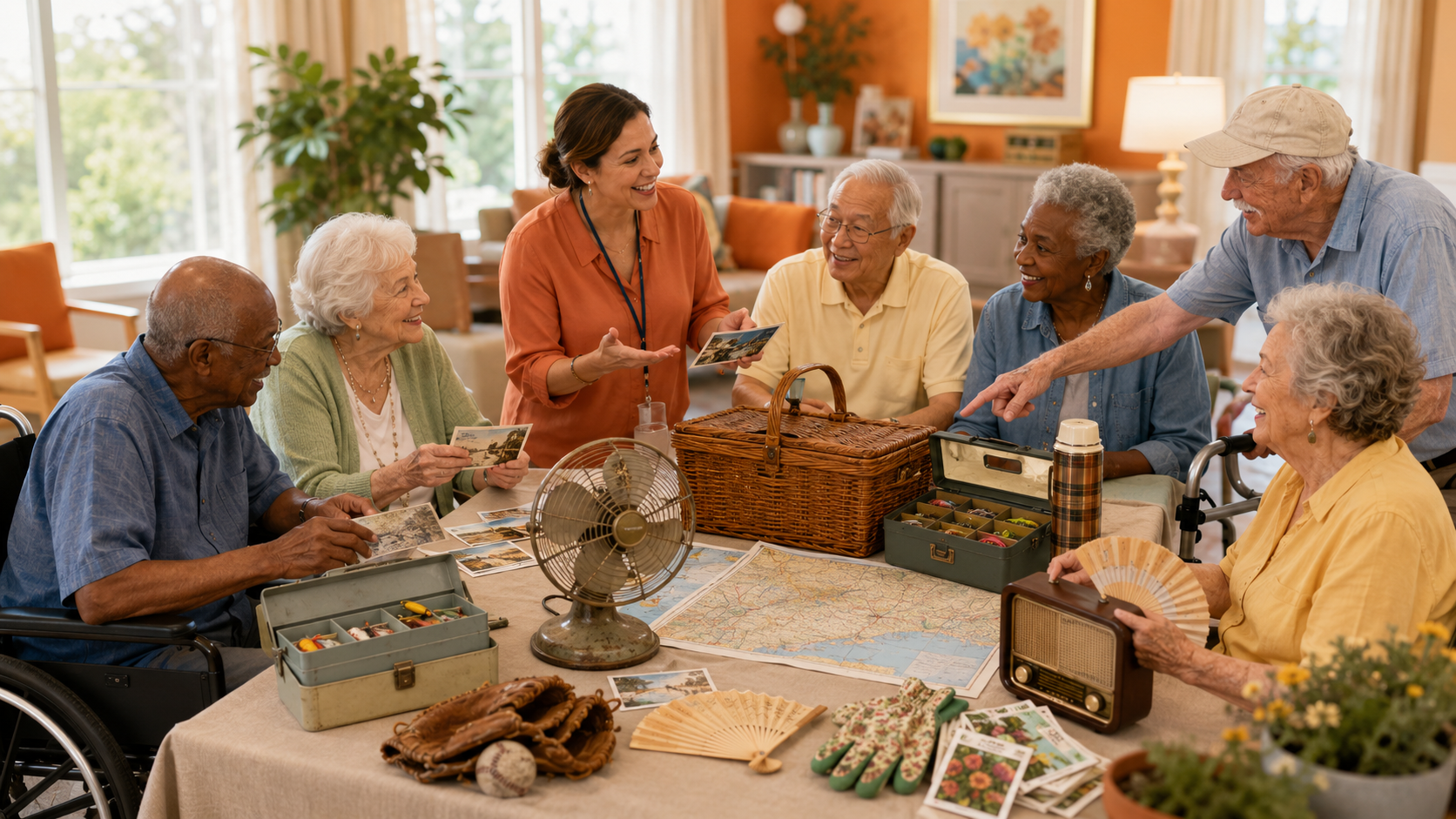
A Summer Objects Museum is a simple pop-up display made from familiar seasonal items.
The objects do not need to be expensive or rare. They just need to feel familiar.
Possible items include:
- metal fan
- paper fan
- old road map
- postcards
- fishing lure
- small tackle box
- baseball glove
- picnic basket
- seed packet
- garden glove
- thermos
- vintage sunglasses
- handkerchief
- old recipe card
Invite residents to help create memory-based labels instead of formal museum labels.
For example:
- “The fan that ran all night before air conditioning.”
- “The road map nobody could ever fold back correctly.”
- “The picnic basket that meant fried chicken was coming.”
- “The glove that lived in the back seat all summer.”
- “The thermos Dad took fishing.”
Programming twist: Ask staff and families to contribute one safe summer object with a short story attached.
Why it works: Familiar objects often unlock memory more naturally than direct questions. They also give quieter residents something concrete to look at, touch, or respond to.
Related reading:
One Small Shift for More Meaningful Activities in Senior Living
The Activity Directors Bible
A complete operational guide for Activity Professionals who want stronger systems, better documentation, and more confidence in daily practice.
Built to help you organize your department, support survey readiness, and stop reinventing everything from scratch.
Care Plan Support
Programming Tools
5. Create a Postcards from July Project
July naturally connects to travel, summer camps, family visits, road trips, military service, vacations, roadside attractions, and places residents once loved.
Set up a postcard writing table where residents can send short notes to family members, friends, volunteers, staff, local veterans, children’s programs, or another senior living community.
Use simple prompts to make writing easier:
- One thing I remember about summer is…
- My favorite July food was…
- A place I loved visiting in the summer was…
- When I was young, July meant…
- My advice for enjoying hot weather is…
- One summer memory I still think about is…
Residents who do not want to write can still participate by choosing postcard images, adding stickers, stamping cards, dictating messages, sorting finished cards, or helping create a postcard wall.
Why it works: This project combines memory, purpose, fine motor engagement, communication, and social connection.
6. Turn Watermelon into a Field Lab
Watermelon is a July classic, but it does not have to be served as a simple snack and forgotten.
Turn it into a playful Watermelon Field Lab.
Possible stations include:
- guess the weight of the watermelon
- seeded versus seedless discussion
- watermelon trivia
- favorite summer fruit voting board
- design a roadside watermelon stand sign
- watermelon memory prompts
- summer produce discussion
Use prompts such as:
- Did your family grow watermelon or buy it?
- Did you ever eat watermelon outside?
- Did anyone in your family put salt on watermelon?
- Where did your family buy summer produce?
- What fruit tasted most like summer to you?
Care note: Always follow dietary orders, swallowing precautions, food texture needs, fluid restrictions, infection control procedures, and facility policies when offering food-based programming.
7. Start a Summer Jobs Hall of Fame
Many residents have summer work memories.
They may have babysat, mowed lawns, picked crops, helped on farms, waited tables, worked in stores, cleaned houses, delivered papers, sold produce, lifeguarded, worked at camps, or helped with family businesses.
Create a Summer Jobs Hall of Fame to honor those stories.
Prompt questions might include:
- What was your first summer job?
- How much did you get paid?
- Did you work outside in the heat?
- What job taught you the most?
- What did you buy with money you earned yourself?
- Did you save your money or spend it right away?
Create paper “paychecks,” name cards, or display badges with resident names and job titles.
Examples:
- Mary — Babysitter, 1956
- James — Grocery Stocker, 1962
- Ruth — Peach Picker, 1948
- Walter — Lawn Mowing Business Owner, Age 14
- Helen — Soda Fountain Helper, 1953
Why it works: This activity recognizes residents as people with skills, responsibility, work ethic, humor, and life experience.
8. Host a Blue Ribbon Oddities Fair
County fair themes are common in July and August, but they do not have to be limited to pies, crafts, and carnival games.
Try a Blue Ribbon Oddities Fair that celebrates personality, humor, and resident stories.
Possible blue ribbon categories include:
- Best Story About a Family Vacation
- Most Unusual Summer Job
- Best Advice for Surviving the Heat
- Funniest Picnic Disaster
- Best Front Porch Memory
- Most Creative Use of a Paper Fan
- Best “Back in My Day” Summer Tip
- Most Memorable Road Trip Story
Residents can submit answers verbally, in writing, through staff interviews, during small groups, or through one-on-one visits.
Programming twist: Display entries with ribbon graphics and invite residents, families, or staff to vote on lighthearted categories.
Why it works: This keeps the fair theme but makes residents the center of the program.
9. Make a Sounds of July Program
July has a soundscape of its own.
Crickets. Screen doors. Lawn mowers. Baseball games. Sprinklers. Thunderstorms. Marching bands. Boat motors. Ice cream trucks. Children playing outside. Fireworks in the distance.
Create a sound-based reminiscence activity where residents listen to short sound clips and guess the sound.
After each sound, ask what memory it brings up.
Sound ideas include:
- crickets at night
- rain on a roof
- baseball crowd
- sprinkler sounds
- screen door closing
- boat motor
- ice cream truck music
- marching band
- summer thunder
Memory care adaptation: Use fewer sound clips, repeat them as needed, pair each sound with a picture, and focus on recognition, expression, and emotional response rather than correct answers.
Why it works: Sound can be a powerful cue for memory and emotion, especially for residents who may not respond easily to discussion-only activities.
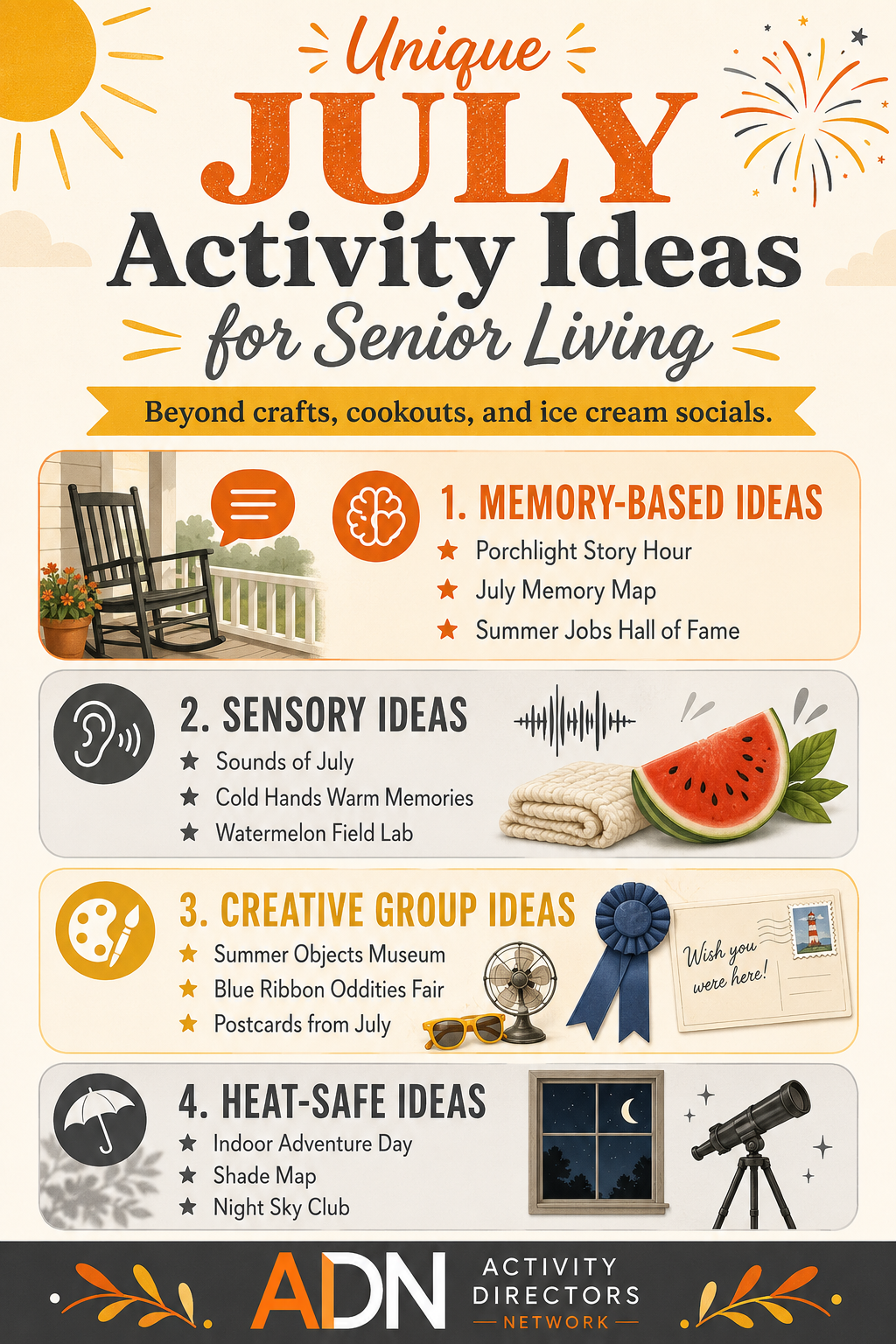
Save this idea for future activity planning, calendar development, and senior living programming inspiration.
10. Offer a Cold Hands, Warm Memories Sensory Program
July can be hot, tiring, and overstimulating for some residents.
A cooling sensory program can offer comfort while creating space for gentle reminiscence.
Possible items include:
- cool washcloths
- paper fans
- soft summer music
- photos of lakes, creeks, pools, and shaded porches
- smooth stones or shells
- mint or cucumber scent, if appropriate
- hand lotion, if allowed
- iced water pitchers for visual atmosphere, following care needs
Conversation prompts might include:
- How did you cool off before central air conditioning?
- Did you swim in a pool, lake, pond, creek, or river?
- What was the coolest room in your childhood home?
- Did your family use fans, shade trees, or open windows?
- What summer drink did your family make?
Care note: Check allergies, skin precautions, temperature sensitivity, fluid restrictions, scent sensitivities, and facility policies before using lotions, scents, cold items, food, or drinks.
11. Design a Shade Map of the Community
This is a practical July activity that can improve daily quality of life.
Invite residents to help identify the best shady, breezy, comfortable places around the building or campus.
These might include:
- front porch
- covered patio
- courtyard corner
- garden bench
- gazebo
- lobby window
- morning coffee spot
- best place to watch visitors come in
Create a visual “Shade Map” that shows where residents can enjoy fresh air, natural light, or seasonal views at different times of day.
Add resident comments such as:
- Best place to hear birds
- Best shady spot after lunch
- Best place for morning coffee
- Best window when it is too hot outside
- Best place to people-watch
Why it works: This activity supports resident voice, orientation to the environment, outdoor engagement, safety awareness, and practical comfort.
12. Start a Night Sky Club
July nights can bring up memories of stars, campfires, camping, late drives, fireworks, sleeping porches, and staying outside after dark.
A Night Sky Club can be held in the evening, after supper, or during the afternoon with dimmed lights and a calm atmosphere.
Program ideas include:
- moon and star coloring pages
- soft music about night or summer evenings
- resident memories of camping or sleeping outside
- simple constellation discussion
- painting a moonlit landscape
- creating a “wishes under the stars” display
- projecting stars on the ceiling, if available
Memory care adaptation: Use dark blue paper, silver stickers, soft music, and simple repeated phrases such as “summer night,” “stars,” “moonlight,” and “peaceful evening.”
Why it works: This creates a calmer July option for residents who may not enjoy loud celebrations, crowded socials, or busy daytime events.
13. Create a July Then and Now Wall
A July Then and Now Wall can become an easy intergenerational and reminiscence display.
Create sections such as:
- ways to cool off
- summer clothes
- family vacations
- July foods
- outdoor games
- summer jobs
- music and entertainment
- holiday traditions
Invite residents, staff, families, and volunteers to add memories or comments.
Examples:
- Then: sleeping with the windows open
- Now: air conditioning everywhere
- Then: paper road maps
- Now: phone directions
- Then: neighborhood kids outside until dark
- Now: scheduled activities and indoor entertainment
Programming twist: Use the wall during family visits, volunteer programs, or intergenerational activities with children and teens.
How to Make July Activities More Meaningful
The most meaningful July programs are not always the most complicated.
They are the ones that connect the season to the resident.
Activity Professionals can improve almost any July activity by adding better prompts, sensory cues, choice, and personal storytelling.
Instead of only planning a picnic, ask what picnic food residents remember most.
Instead of only playing patriotic music, ask what songs remind residents of summer gatherings.
Instead of only serving watermelon, ask where residents bought it, grew it, or ate it.
Instead of only decorating with summer images, ask residents which images actually feel like July to them.
Those small shifts can turn a familiar activity into a person-centered experience.
July Activity Documentation Ideas
Unique July activities can also create stronger documentation.
Instead of only recording attendance, Activity Professionals can document response, choice, memory, mood, sensory engagement, social interaction, and meaningful participation.
Instead of writing:
“Resident attended July activity.”
An Activity Professional might document:
Documentation Example: Resident participated in Porchlight Story Hour and shared memories of sitting outside with family after supper during childhood summers. Smiled during discussion, responded to cricket sounds, and remained engaged for approximately 25 minutes.
That kind of note tells a stronger story.
It shows memory.
It shows response.
It shows sensory engagement.
It shows connection to personal history.
It shows meaningful participation.
And that matters because activity programming is not just about filling time.
It is about supporting quality of life.
Final Thoughts
July does not have to be predictable.
It can be warm, creative, sensory, nostalgic, calming, funny, practical, and deeply personal.
Activity Professionals can use July to help residents reconnect with summer memories, family traditions, outdoor rhythms, work history, travel stories, favorite foods, local culture, and the simple comfort of the season.
The goal is not to avoid classic July activities altogether.
The goal is to make the calendar feel alive again.
Residents deserve more than a recycled summer schedule.
They deserve programs that help them remember, contribute, laugh, choose, connect, and feel like July still belongs to them.
You may also want to explore:

Frequently Asked Questions
What are unique July activity ideas for senior living?
Unique July activity ideas for senior living include porch storytelling, summer object museums, postcard projects, indoor adventure days, sound-based reminiscence, cooling sensory programs, summer job displays, shade maps, July memory walls, and blue ribbon oddities fairs.
How can Activity Directors make July programming more meaningful?
Activity Directors can make July programming more meaningful by connecting activities to resident memories, seasonal routines, personal preferences, sensory cues, family traditions, work history, favorite foods, and opportunities for choice and storytelling.
What are heat-safe July activities for residents?
Heat-safe July activities may include indoor fishing games, virtual lake visits, cool towel sensory programs, postcard writing, summer sound guessing games, indoor camping themes, shaded courtyard coffee groups, and window-based nature observation.
How can July activities support documentation?
July activities can support documentation by creating observable resident responses such as reminiscence, social interaction, sensory engagement, emotional expression, participation, choice-making, comfort, and connection to personal history.