
Most activity departments do not begin with a manual. They begin with the basics: a calendar, a box of supplies, a few traditions, and a professional doing their best to create meaningful days for the residents they serve. Over time, the department grows. Programs become more structured. Staff develop routines. Forms are created. Good habits take shape.
And for a while, that can work surprisingly well. The department runs because the Activity Director knows how it works. The assistant learns by watching. The team figures things out through repetition and experience. The structure exists, but it lives mostly in people rather than on paper.
That is often the moment when an activity department feels functional, but not yet protected.
An operations manual does not exist to create busywork.
It exists to protect the structure, standards, and systems that keep an activity department running clearly and consistently.
The need for a manual usually becomes obvious when something changes. A survey is coming. A new administrator asks for department policies. A staff member leaves. A new hire asks where the participation records are kept, how one-to-one visits are documented, or what the department procedure is for Resident Council minutes, volunteer sign-in, pet visits, or monthly calendar retention.
Those are not complicated questions, but they reveal something important. Many departments are running on memory and habit rather than written structure. The systems may be there. They simply are not gathered in one organized place.
That creates stress where there does not need to be stress. Instead of being able to open a department manual and point to the process, the Activity Director has to explain it verbally, search through old binders, or recreate the answer from memory.
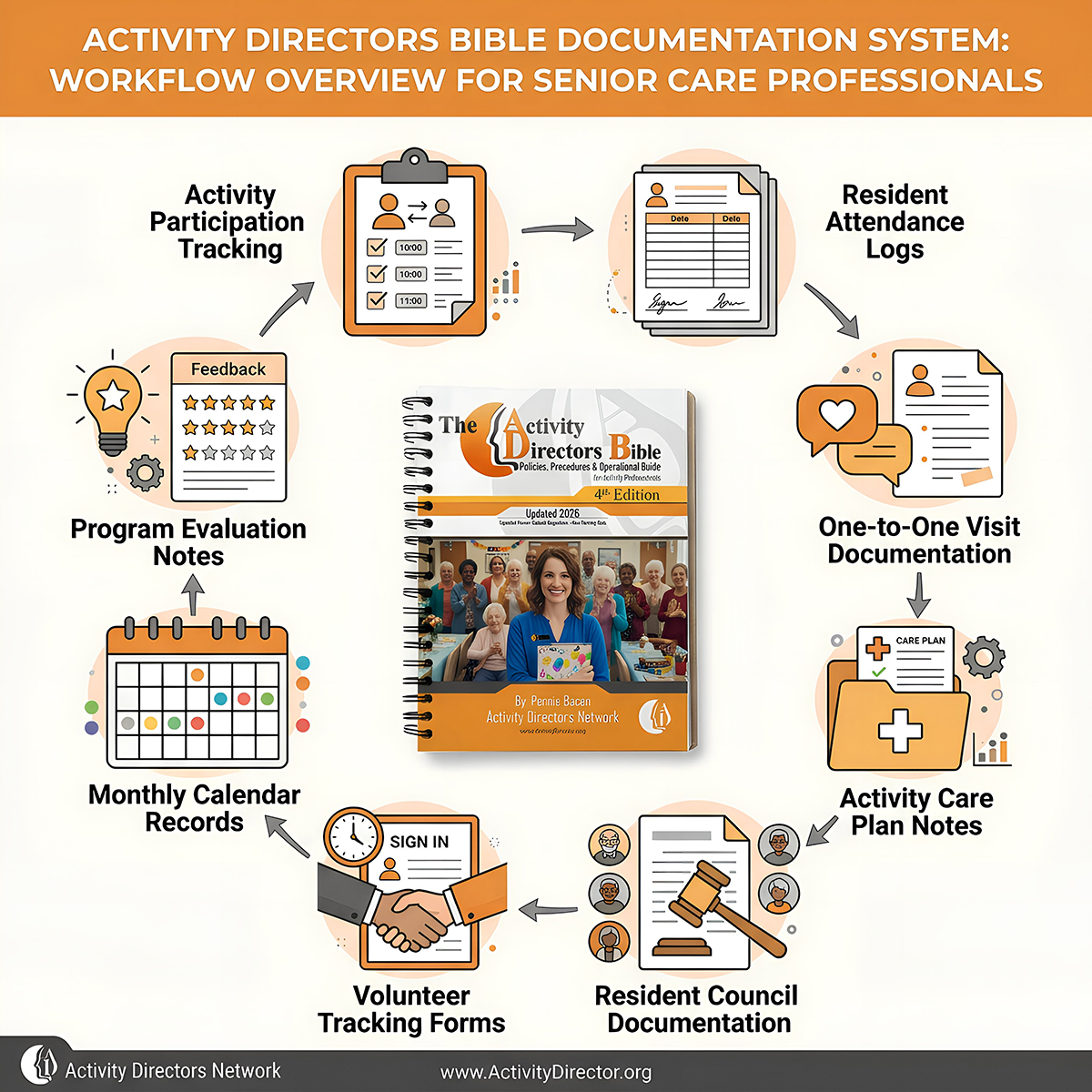
A written operations manual changes that. It gives the department a home for its structure. It defines expectations. It supports consistency. It helps preserve knowledge so the department does not have to be rebuilt every time staffing changes or a new question comes up.
A strong manual can include job roles, programming expectations, documentation standards, Resident Council systems, volunteer procedures, budgeting forms, safety references, quality assurance tools, and participation tracking processes. In other words, it becomes the working framework behind the department rather than a pile of disconnected papers living in drawers, notebooks, and old file folders.
This matters not just for organization, but for continuity. When systems are not written down, every Activity Director ends up reinventing them. Policies get rewritten. Forms get recreated. Processes are re-explained. Valuable time is spent rebuilding what should already exist.
What a manual really gives an activity department
It gives the team a shared reference point.
It gives leadership a clearer picture of how the department functions.
It gives new staff a foundation to step into.
And it gives the department a way to hold onto its systems instead of losing them every time people change.
Over the years, we kept seeing this same challenge in facilities of every size. Good departments were doing good work, but the systems behind that work were rarely gathered into one organized manual. The department might have excellent programming, thoughtful staff, and strong resident relationships, yet still lack a written operational backbone.
That is one of the reasons the Activity Directors Bible was created.
It was designed to bring together the structure that many departments need but do not always have time to build from scratch: policies, procedures, documentation tools, planning systems, participation records, quality references, and operational forms that support the daily work of Activity Professionals.
The goal is not more complexity
The goal is clarity. A department that has clear written systems is easier to manage, easier to explain, easier to hand off, and easier to strengthen over time.
If your department has grown through habit, memory, and experience, you are not behind. That is how many departments have been built. But there comes a point when writing the structure down becomes one of the best ways to protect the work you have already done.
Looking for a complete foundation?
The updated 2026 Activity Directors Bible was created to help Activity Professionals organize the systems behind their department with more confidence and less guesswork.